

Executive Summary
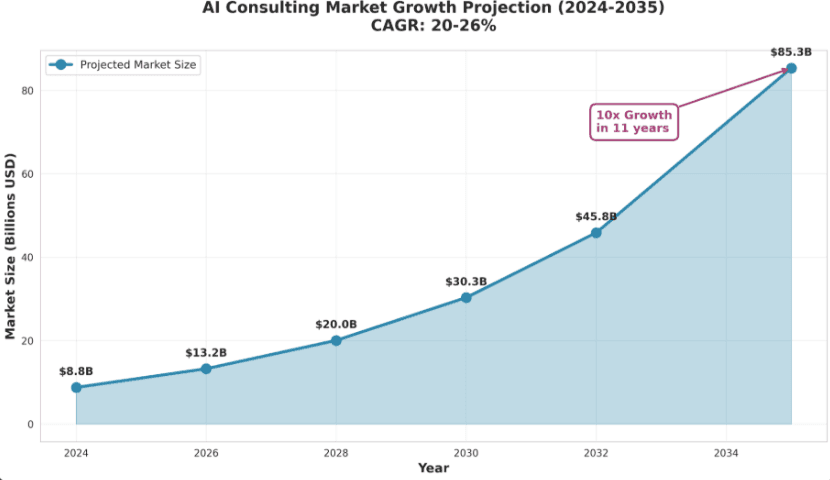
AI and automation are transforming the consulting industry—not replacing consultants, but changing how firms operate, price services, and deliver value. The AI consulting market is growing rapidly, from $8.75 billion in 2024 to an expected $90.99 billion by 2035, representing 20-26% annual growth.
AI automates routine junior tasks, allowing firms to focus consultants on strategic work. However, challenges exist: entry-level hiring is declining, pricing is shifting from hourly to outcome-based, and many lack AI skills. Firms that invest in AI training and adapt their business models will succeed.
1. Market Overview
Market Size and Growth
The AI consulting market is growing rapidly. It will expand from $8.75 billion in 2024 to $90.99 billion by 2035—a 20-26% annual growth rate, far exceeding traditional consulting growth. Global AI spending is projected to reach $2.52 trillion in 2026, up 44% from 2025.
Metric | Value |
Current Market (2024) | $8.75 billion |
Projected Market (2035) | $90.99 billion |
Annual Growth Rate | 20-26% CAGR |
Investment Trends
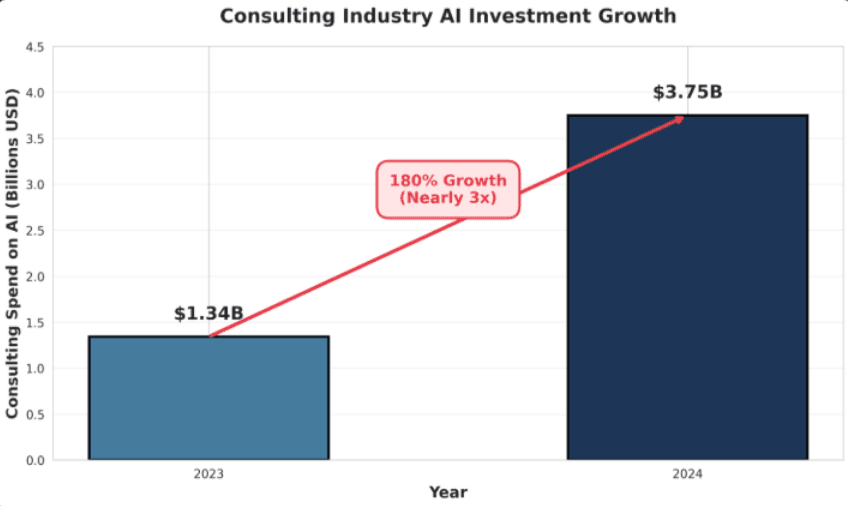
Consulting firms are rapidly investing in AI capabilities. Consulting spend on AI tripled from $1.34 billion in 2023 to $3.75 billion in 2024. Major firms like McKinsey have deployed AI tools across their entire workforce, with over 70% of the firm's 45,000 employees now using their proprietary Lilli AI tool, which answers 500,000 queries monthly.
2. Impact on Roles and Hiring
Entry-Level Position Changes
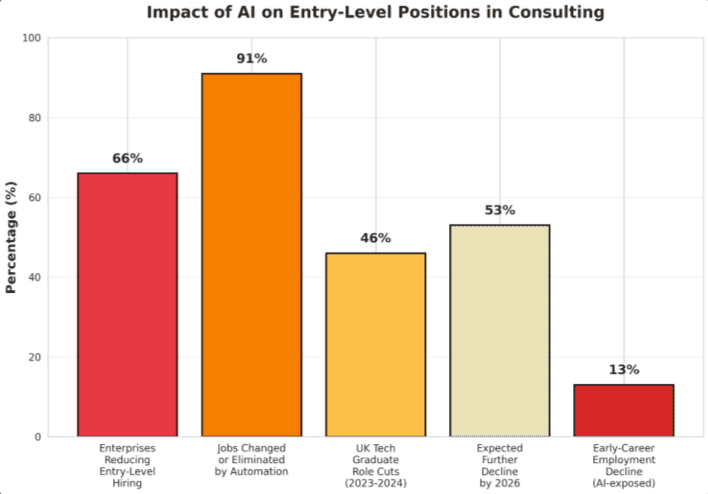
The consulting industry is experiencing significant changes in entry-level hiring and roles. Automation is eliminating many traditional junior consultant positions, while simultaneously creating demand for new skill sets.
Metric | Finding |
Enterprises reducing entry-level hiring | 66% |
Jobs changed or eliminated by automation | 91% |
UK tech graduate role cuts (2023-2024) | 46% |
Expected further decline by 2026 | 53% |
Early-career employment decline (AI-exposed) | 13% |
Role Transformation
AI is not eliminating junior consultant roles—it's changing what they do. Routine tasks like report writing and data analysis are automated, freeing junior consultants to focus on client relationships, problem-solving, and strategic insights. However, this shift requires training and upskilling.
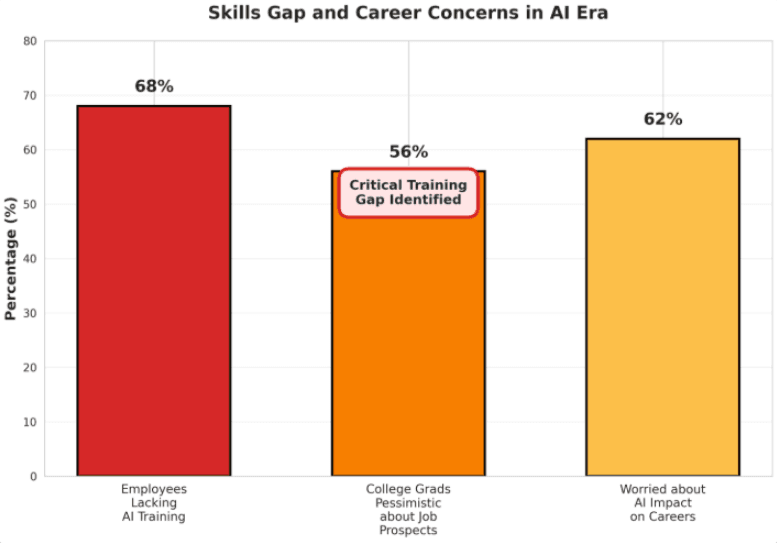
A major challenge: 68% of employees lack AI training, creating a skills gap. Additionally, 56% of 2025 college graduates are pessimistic about job prospects, and 62% worry about AI's impact on their careers.
3. Productivity Gains
Time Savings from AI
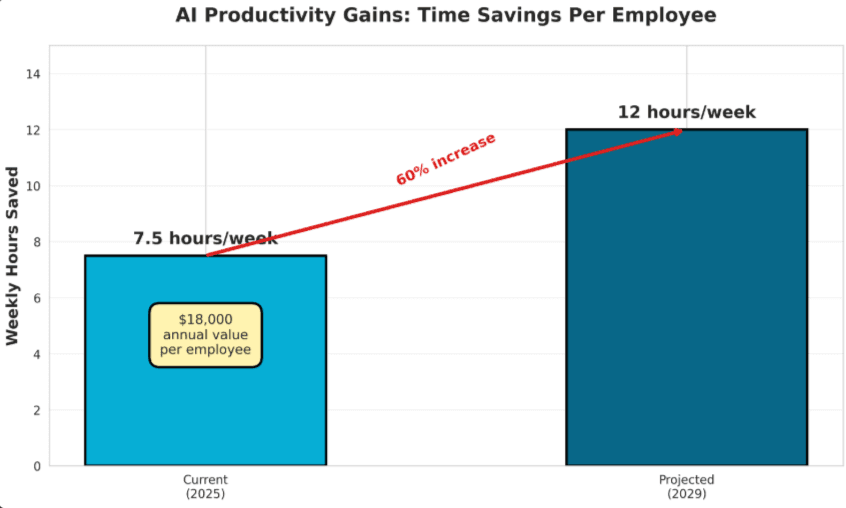
AI tools boost productivity significantly. Employees save 7.5 hours per week—one full workday—worth about $18,000 annually per employee. By 2029, this is projected to reach 12 hours per week.
Timeframe | Weekly Hours Saved |
Current (2025) | 7.5 hours |
Annual Value | $18,000 per employee |
Projected (2029) | 12 hours |
Training Impact
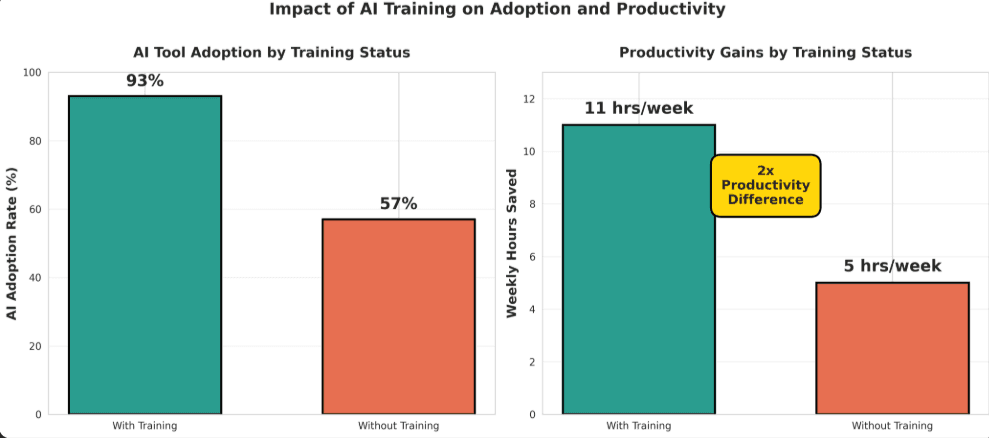
AI training significantly influences adoption and productivity. Employees with AI training are twice as productive as those without, saving 11 hours per week versus 5 hours. However, the training gap remains substantial.
Metric | Percentage |
Employees with training using AI | 93% |
Employees without training using AI | 57% |
Multigenerational teams reporting productivity | 77% |
4. Business Model Evolution
Pricing Model Shift
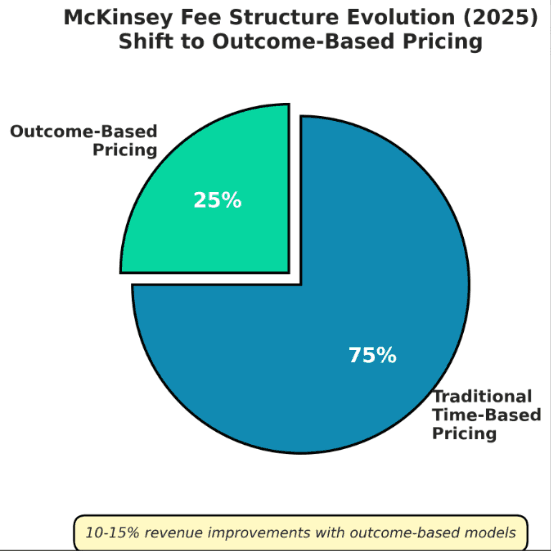
The consulting industry is transitioning from time-based billing to outcome-based pricing. As AI automates routine analysis, clients increasingly demand to pay for results rather than hours worked. This shift reflects the changing value proposition of consulting services.
· 25% of McKinsey's fees are now outcome-based (2025)
· Outcome-based pricing models deliver 10-15% revenue improvements
· Clients demand greater transparency and fair value-sharing
· Consultant value now derives from strategy, relationships, and complex problem-solving
Profit Margin Expansion
An economic tension exists: AI has cut consulting delivery costs, but prices remain unchanged. This widens the gap between what firms spend and what they charge, increasing profits without passing savings to clients. As a result, clients are renegotiating contracts and demanding outcome-based pricing.
5. Future Outlook
Corporate Investment Plans
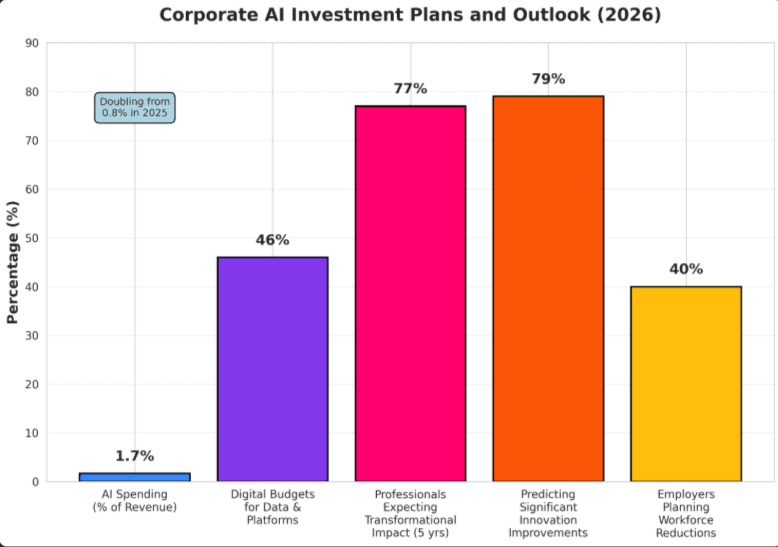
Organizations are significantly increasing AI investment. Corporations expect to double AI spending in 2026, from 0.8% to 1.7% of revenues. This reflects the strategic importance of AI across all business functions.
· Corporations doubling AI spending in 2026
· 46% of digital budgets allocated to data and platform digitization
· 77% of professionals expect AI to have transformational impact (5 years)
· 79% predict significant innovation improvements
· 40% of employers plan workforce reductions where AI can automate
6. Key Findings
1. The AI consulting market will grow from $8.75B (2024) to $90.99B (2035), a 20-26% annual growth rate.
2. Entry-level hiring is declining significantly (66% of enterprises reducing junior roles), but junior positions are transforming rather than disappearing.
3. AI delivers measurable productivity gains: 7.5 hours per week currently, projected to reach 12 hours by 2029.
4. Training is critical: employees with AI training are 2x more productive and 93% adopt AI versus 57% without training.
5. Pricing models are shifting from time-based to outcome-based, with 25% of major consulting fees now outcome-driven.
6. A significant skills gap exists: 68% of employees lack recent AI training, creating both risk and opportunity.
7. The consulting industry is being reshaped, not replaced—successful firms will integrate AI while maintaining human expertise in strategy and client relationships.
7. Recommendations
1. Invest in comprehensive AI training programs to close the skills gap and maximize productivity gains.
2. Transition business models toward outcome-based pricing to align with client expectations and market trends.
3. Reposition junior consultants toward strategic and client-facing work rather than routine analysis.
4. Develop hybrid human-AI workflows that leverage automation for efficiency while maintaining human judgment.
5. Establish transparent value-sharing models with clients to ensure fair distribution of AI-driven productivity gains.
6. Build diverse, multigenerational AI teams to improve innovation and decision-making.
Conclusion
AI and automation are not threats to consulting—they are catalysts for evolution. The industry is experiencing unprecedented transformation: market growth, shifting business models, changing roles, and new value propositions. Organizations that successfully navigate this transition will be those that invest in AI capabilities, adapt their business models, and empower consultants to focus on uniquely human skills: strategy, creativity, and complex problem-solving.
The future of consulting lies not in human versus machine, but in the intelligent combination of both. Consulting firms that embrace this reality will thrive; those that resist will be left behind.